
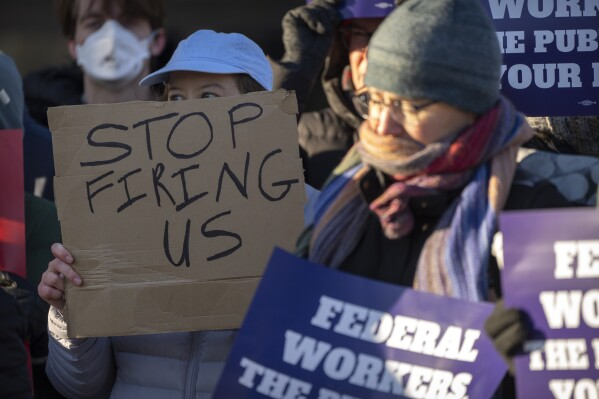

Mass Dismissals Reshape the Federal Workforce
The Trump administration has directed federal agencies to carry out widespread layoffs, primarily targeting probationary employees—staff who have worked in the government for less than a year or, in some cases, two years. These employees have fewer job protections and limited appeal rights, making them more vulnerable to termination.
The layoffs began earlier this week, impacting multiple agencies, including the Departments of Energy, Veterans Affairs, Education, Interior, and Health and Human Services. The Office of Personnel Management (OPM), which oversees federal workforce policies, instructed agencies to move forward with the dismissals as part of a broader effort to “streamline the government” and cut costs.
Scope of the Layoffs
The exact number of affected employees remains unclear, but estimates suggest that tens of thousands of workers have already been dismissed, with more terminations expected in the coming weeks. Key agencies impacted include:
- Department of the Interior – Over 2,200 employees dismissed, including staff from the Bureau of Land Management, National Park Service, and Fish and Wildlife Service.
- Department of Veterans Affairs (VA) – More than 1,000 employees let go, with officials claiming it will save the department $98 million annually.
- Department of Energy – Approximately 2,000 employees affected, leading to concerns about the agency’s ability to maintain critical operations.
- Centers for Disease Control and Prevention (CDC) – Nearly 1,300 employees, including members of the Epidemic Intelligence Service, dismissed. This team has historically played a key role in responding to public health emergencies.
- US Forest Service – 3,400 employees fired, raising concerns about wildfire response capabilities.
Employees were notified of their terminations via emails, form letters, and video calls, with some given as little as 30 minutes to vacate their offices.
Government Justification and Response
A spokesperson for OPM defended the move, stating that the probationary period is an extension of the hiring process, not a guarantee of permanent employment. The administration argues that the layoffs are necessary to eliminate inefficiencies and reduce government spending.
President Trump, alongside Elon Musk, head of the newly formed Department of Government Efficiency (DOGE), has positioned the firings as part of a major federal workforce overhaul. Trump has long criticized the size and inefficiency of the government, and Musk has publicly stated that some agencies should be “deleted entirely”.
However, labor unions and employees argue that the terminations are not performance-based but rather a politically motivated effort to downsize the federal workforce quickly.
Union and Employee Reactions
Federal employee unions, including the American Federation of Government Employees (AFGE) and the National Federation of Federal Employees (NFFE), have strongly opposed the mass firings.
- AFGE President Everett Kelley called the dismissals “a politically driven mass firing spree” and stated that “these firings are not about poor performance but about power.”
- NFFE President Randy Erwin warned that the layoffs would “put a massive strain on public services that millions of Americans depend on.”
- Multiple unions have filed lawsuits against the administration, arguing that the terminations violate federal procedures for workforce reductions.
Potential Impact on Public Services
The layoffs are expected to have long-term consequences on federal operations.
- The CDC dismissals could delay public health responses to disease outbreaks.
- The US Forest Service cuts may reduce wildfire prevention efforts ahead of peak fire season.
- The Department of Veterans Affairs layoffs could slow down services for military veterans.
Additionally, some agencies have been struggling with staff shortages even before the layoffs. Many worry that losing probationary employees—often younger workers with specialized skills—could further weaken government efficiency in the long run.
What Happens Next?
The Trump administration has not ruled out additional workforce reductions, and more agencies are expected to announce further dismissals in the coming weeks.
Meanwhile, unions are exploring legal challenges to the firings, and Democratic lawmakers have condemned the move, calling it an attack on career civil servants.
With public services under strain and uncertainty growing in the federal workforce, the effects of these mass layoffs will likely be felt for years to come.